



Light emitting diodes (LEDs) have become the dominant light in general lighting today , by converting electrical energy into visible light of high efficiency, long lifetime, and small size. However,in describing what LED lights are, it reveals that there are in fact many different types of products. Although they all contain the same semiconductor chip as the basis for the electroluminescence in a p-n junction — the way the chips are assembled, connected, coated, and mounted determines how the light is emitted, how the heat is removed, and where each light source performs best.
This article explains, from an objective and scientific standpoint, what a COB LED light is, what an SMD LED light is, and how they differ. Understanding these differences is not an academic exercise: it directly affects beam control, color uniformity, thermal design, driver selection, cost, and ultimately the quality of the finished lighting product.
What Is a COB LED Light ?
Definition and packaging structure
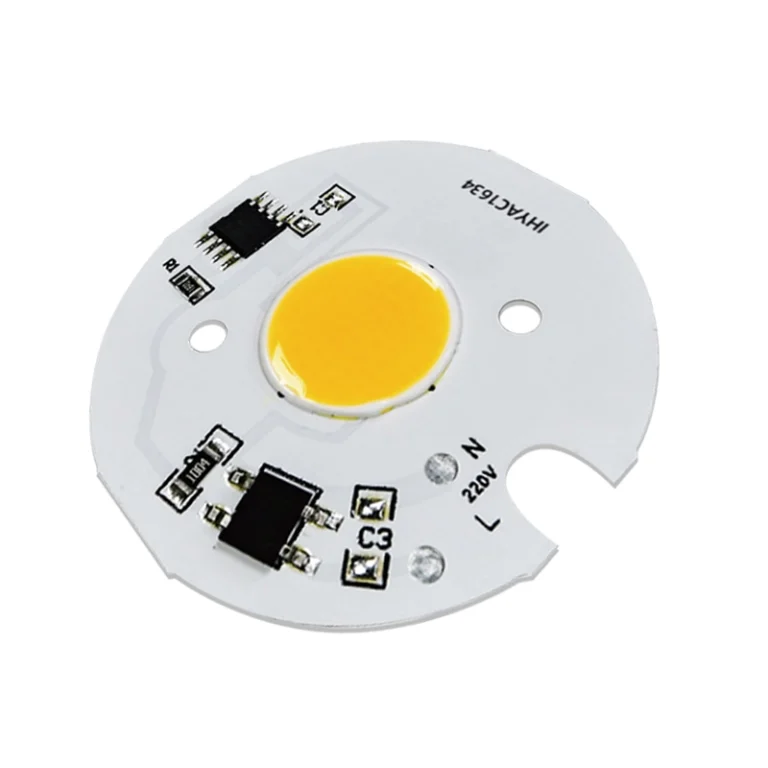
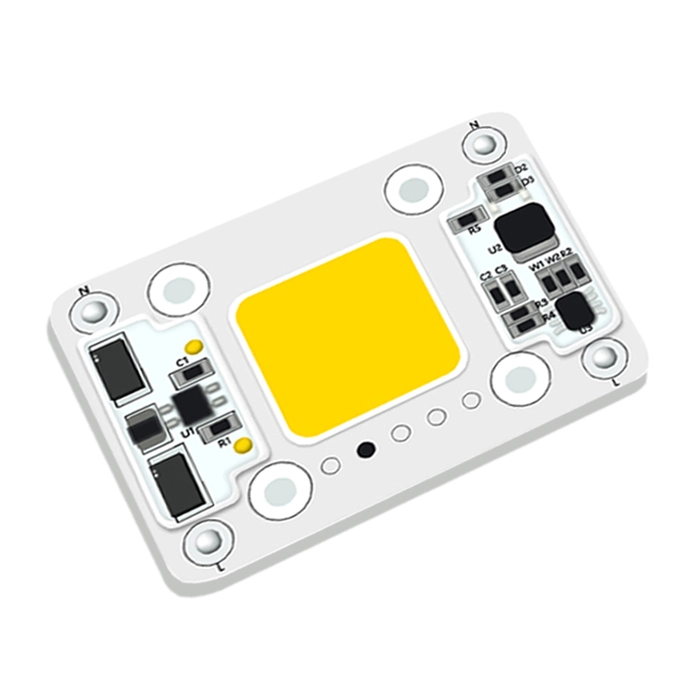
COB stands for “Chip on Board”. Replacing traditional individually packaged diodes, COB LED technology directly embeds score-sized or hundred-strong clusters of bare semiconductor dies onto a thermally conductive base made of ceramic, copper, or aluminum. Microscopic wire bonding interlinks these unencapsulated chips across series, parallel, or hybrid circuit pathways. To complete the assembly, a continuous coating of silicone embedded with phosphor particles encapsulates the entire diode matrix into a unified luminous surface. The result is one compact module with one continuous light-emitting surface (LES).
How a COB LED produces white light?
White emitting COB arrays operate by converting narrow band blue light into a broad white spectrum, a mechanism shared across white LED technology. enerating white light begins when unencapsulated InGaN (indium gallium nitride) chips emit narrow-band blue light through a yellow-phosphor-doped silicone layer. Rather than converting the entire beam, the phosphor host selectively absorbs a fraction of the blue flux to excite cerium dopants, prompting yellow luminescence. The untouched blue light continues forward, blending naturally with the newly generated yellow wavelengths to output a broad-spectrum white glow. Because every die in the array shares a single phosphor blanket, color mixing occurs within the module encapsulation, yielding a smooth, edge-to-edge luminous area rather than a grid of isolated light points..
The architecture also creates two distinctive engineering advantages. Delivering immense brightness from a small footprint gives COB arrays two major structural advantages: precise beam shaping and efficient thermal management. Gathering significant luminous flux onto a tiny LES yields high surface brightness (cd/m²) allowing reflectors and optics to project narrow, controlled beams with negligible stray light. This makes COB engines ideal for directional applications like spotlights, downlights, and task lighting.From a thermal standpoint, mounting dies directly to the base plate provides an uninterrupted pathway for heat to escape into the heatsink. Dropping this thermal resistance keeps junction temperatures low, which prevents efficiency drops and slows lumen degradation over the product’s lifespan. Modern COB LED modules span from low power decorative chips to massive 800W commercial floodlights, covering color temperatures between 1800K and 20,000K and CRI ratings above 90 for color critical environments.
What Is an SMD LED Light ?
Definition and packaging structure
SMD stands for “Surface Mount Device”. An SMD LED is a discrete, individually packaged component in which a single LED chip (or a small number of chips) is mounted inside a lead frame, connected by wire bonds, surrounded by a reflector cup, coated with phosphor, and sealed with an encapsulant or lens. The finished package has solder terminals on its underside and is mounted on a printed circuit board (PCB) by reflow soldering. Package sizes are named by their footprint in tenths of a millimeter — 2835, 3030, 3528, 5050, 5630, and so on — so a 2835 package measures 2.8 mm × 3.5 mm.
How an SMD LED produces white light?
The light generation physics of an SMD LED is identical to that of a COB LED: a blue chip excites a phosphor, and the mixed light leaves the package as white light. The decisive difference is optical independence. Each SMD package is its own light-emitting unit, so a populated board is effectively an array of many small point sources. Without a diffuser or secondary optics, the individual light spots are often visible, and the luminance of any single package is far lower than that of a COB LED module of similar total flux.
This distributed architecture, however, is exactly what makes SMD LEDs flexible. Surface-mount devices (SMD) offer exceptional layout flexibility since engineers solder discrete LED packages directly onto custom circuit boards—enabling tailored configurations ranging from linear strips and concentric rings to complex grid matrices. This architecture allows individual components or specific circuit channels to be independently driven, dimmed, or dynamically controlled, unlocking advanced functionality like dynamic RGB mixing, tunable correlated color temperature (CCT), and addressable digital signage. Consequently, SMDs serve as the primary light engine for flex tapes, troffer panels, retrofit lamps, and display backlights, relying on secondary diffusers to transform multiple point sources into soft, even illumination.
Key Differences Between COB LED and SMD LED Light
The table below summarizes the main differences between COB LED and SMD LED light from the perspective of packaging, optics, thermal behavior, and application.
| Aspect | COB LED | SMD LED |
| Packaging architecture | Multiple bare chips mounted on one substrate | Discrete packaged components soldered on a PCB |
| Light-emitting surface | One continuous LES | Many individual emitting packages |
| Luminance (cd/m²) | Very high; intense, compact source | Low per package; output distributed |
| Beam control | Excellent with a small LES; tight beams | Requires secondary optics or diffusion |
| Color uniformity | High; no visible dots | Point sources; needs a diffuser |
| Thermal path | Chip → substrate → heat sink | Chip → Lead Frame → Solder → PCB → Heatsink |
| Design flexibility | Fixed chip array per module | Flexible PCB layouts, zoning, RGB |
| Typical power range | Single module from <10W to 800W+ | Usually <3W per package; arrays scale up |
| CRI options | CRI 80–95+ (High CRI / Full Spectrum available) | CRI 80–95+ (High CRI / Full Spectrum available) |
| Typical applications | Spotlights, Downlights, Track lights, High-bay, Work light, Filling light, Projection | Strips, Panels, Bulbs, Signage, General lighting, Display backlights |
Luminance and beam control
The most fundamental difference is optical. Light Density and Beam Control.
Luminance measures the intensity of light coming off a specific surface area. Because a COB module forces immense power through a tiny footprint, its surface brightness is extremely high—making it easy for lenses and reflectors to focus the output into tight, punchy beams. SMD arrays spread that same total light output across a wide board, resulting in lower luminance and a naturally diffuse wash of light. That makes SMDs the go-to for wide-area ambient lighting, while COBs dominate targeted, long-throw applications.
Thermal Efficiency
From a cooling standpoint, COB LEDs sit right on the primary substrate, giving heat a short, single-step escape route to the heatsink. SMDs must push heat through several thermal barriers: the package material, the solder joints, and the circuit board’s copper layers. This added thermal impedance means COB chips can be driven much harder without overheating the semiconductor junction, while high-wattage SMD setups require aggressive heat-spreading PCB design to stay within safe temperature limits.
Reliability and lifetime
Both technologies follow the same lifetime physics: lumen depreciation and failure accelerate with junction temperature, and LM-80 data quantify this relationship. COB LED modules have fewer individual components and a sealed phosphor layer that protects the wire bonds, but a failure in any part of the internal circuit affects the whole module. SMD LED systems gain redundancy — a single failed package does not darken the whole board — but add failure modes such as solder-joint fatigue under thermal cycling.
Electrical design and cost
A COB LED module is normally driven as one load by a constant-current LED driver matched to its forward voltage and current. An SMD LED array can be wired in series, parallel, or series-parallel to fit a chosen driver, giving the designer more electrical freedom. On cost, SMD LED production is extremely mature and cheap per component at scale, which favors high-volume, design-flexible products. COB LED reduces system assembly steps and secondary optics cost, making it competitive for higher-power, optics-driven applications.
How to Choose Between COB LED and SMD LED ?
The choice should be made from the application backward, not from the package forward. Fixtures demanding high optical density and precise directionality—such as work light , machine filling light , spotlights, track heads, recessed downlights, highbay industrial luminaires, stage lighting, or targeted horticultural arrays—benefit most from COB architecture. The high luminance of a compact Light Emitting Surface (LES) maximizes secondary optics efficiency, shaping tightly collimated beams from a single point-like engine. Conversely, applications requiring wide, homogenous illumination across large surface areas—like flexible tape lights, architectural troffers, or backlighting units—are best served by SMD arrays, which leverage light-scattering diffusers to smooth out individual diode emissions. Ultimately, optimal selection hinges on evaluating system-level trade-offs: thermal dissipation budgets, driver topology, form-factor constraints, spectral performance, and cost targets. Both technologies offer exceptional reliability when aligned with a fixture’s overall optical, thermal, and electrical parameters.
Conclusion
COB LED and SMD LED are two packaging strategies for the same semiconductor light source. COB mounts many chips on one substrate to create a single, intense, uniform emitting surface with a short thermal path; SMD places individually packaged components on a PCB to create a flexible, distributed, diffuse light source. Their differences in luminance, beam control, color uniformity, thermal resistance, flexibility, and cost determine where each excels. An objective selection is based not on which technology is “better” in general, but on which one meets the measurable optical, thermal, electrical, and mechanical requirements of the application.
Frequently Asked Questions
Is a COB LED brighter than an SMD LED?
“Brighter” depends on how brightness is defined. Total luminous flux (lumens) depends on power and efficacy, and an SMD array can deliver very high total flux. What COB offers is much higher luminance — more light per unit area — which is what enables tight beams and long-distance throw.
Why do COB LEDs appear as a single, seamless light source?
Since every die in a COB module resides on a shared base plate directly under a unified phosphor canopy, color blending takes place inside the package encapsulation before the light exits. This internal mixing merges individual diode emissions into one broad, continuous field, completely eliminating pixelated dot patterns.
Which technology delivers superior color quality?
Color rendering depends on phosphor chemistry and binning specs rather than the packaging type itself. However, because COB arrays blend all light under one shared phosphor layer, they produce a far more uniform color across the entire beam angle without the color-over-angle (COA) shift or multi shadow artifacts common in SMD arrays.
Can a COB LED replace an SMD LED in an existing fixture?
Rarely without redesign. The LES position, beam, thermal path, electrical interface, and mechanical mounting all differ, so replacement requires checking optical, thermal, electrical, and mechanical compatibility before changing the light source.