



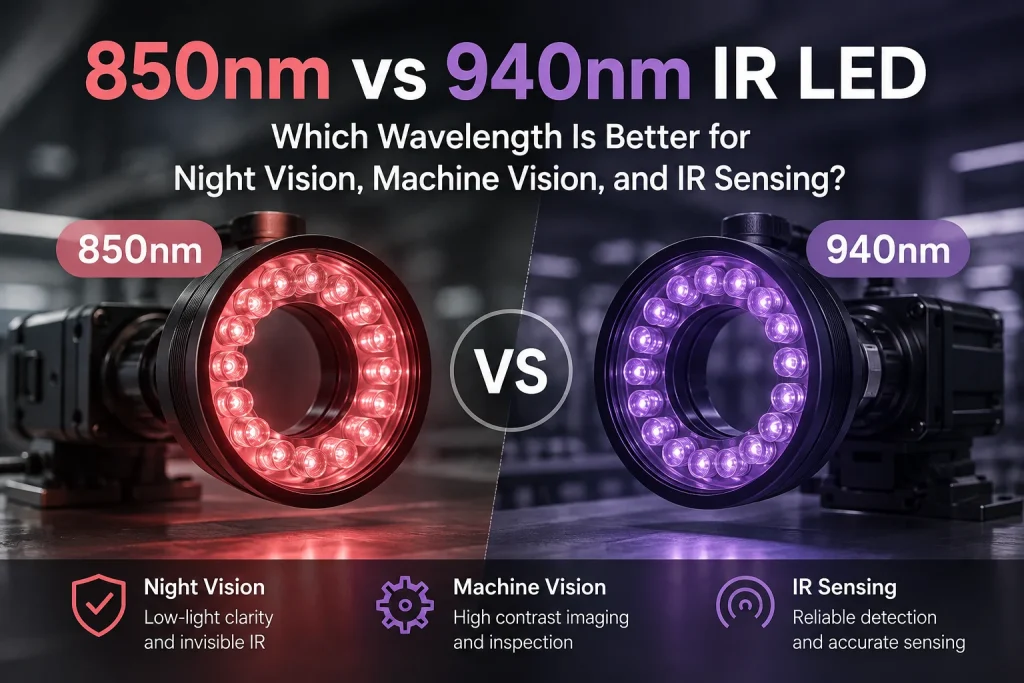
Selecting an 850nm vs 940nm IR LED is not merely about picking the wavelength with greater optical output. For OEM cameras, machine vision, security gear, and infrared sensing devices, the superior choice hinges on the camera sensor’s wavelength response, the acceptable visible red glow, the required working range, the optical path, and electrical/thermal system limits.
In many imaging applications, 850nm is a practical starting point when detected signal and working distance are important. A 940nm source is often considered when reduced visible red glow matters more. Neither wavelength should be selected without checking the complete optical system.
850nm vs 940nm IR LED: Quick Selection Guide
The primary distinction between 850nm and 940nm in an OEM system concerns the interaction of the wavelength with the detector and the application. Camera sensors often exhibit different responses at the two wavelengths, while the visible red glow (to humans) from an IR emitter also varies.
| Selection Factor | 850nm | 940nm |
| Camera response | Often favorable, depending on sensor | Often lower, but sensor dependent |
| Visible red glow | More noticeable | Reduced red glow |
| Covert operation | Less suitable where visibility matters | Often preferred |
| Working distance | Can benefit from stronger detected signal | Must be verified with the actual camera |
| Machine vision | Common candidate for imaging systems | Useful when the sensing architecture favors 940nm |
| Security cameras | Useful when image signal is the priority | Useful when discreet illumination is important |
Choose 850nm When Camera Response and Detected Signal Are the Priority
An 850nm IR LED is often worth evaluating first when the system needs a strong image signal at a defined distance. This can include machine vision, industrial imaging, security cameras, and other equipment where the sensor must collect enough infrared light for reliable detection.
The key step is to check the camera or sensor spectral response curve. A higher emitter output does not automatically produce a brighter or more useful image if the detector responds poorly at that wavelength.
OEM buyers should provide the sensor model, working distance, field of view, illumination area, and required image performance when requesting an IR source. This reduces the risk of selecting an emitter based only on nominal wavelength or electrical wattage.
Choose 940nm When Reduced Visible Red Glow Matters
A 940nm IR LED is commonly considered when the light source should be less noticeable to people near the equipment. This can be relevant to discreet security illumination, user facing sensing, authentication systems, and products where visible red glow could affect the user experience.
The trade off is that the camera may respond differently at 940nm. If sensor sensitivity falls at the longer wavelength, the system may require changes in radiant intensity, exposure, optics, or working distance.
Before selecting 940nm, engineers should confirm that the camera can produce sufficient signal under the intended operating conditions. The correct question is not simply “Is 940nm invisible?” but whether reduced visible emission can be achieved without compromising the system’s detection requirement.
Why 850nm and 940nm Perform Differently With Different Cameras
A common procurement problem appears when the same IR LED module performs well with one camera but poorly with another. This is often caused by the detector and optical path rather than by a defective emitter.
Check the Camera Sensor’s Spectral Response
CMOS and other image sensors do not respond equally to every near-infrared wavelength. The response curve should therefore be reviewed before deciding whether 850nm or 940nm is more suitable.
This is especially important when changing camera models or replacing an existing IR module. If the original system was developed around 850nm, moving to 940nm without checking sensor response may reduce detected signal even if the replacement emitter appears electrically compatible.
For new projects, the camera or sensor model should be part of the RFQ. For replacement projects, the existing light source and camera specifications should be supplied together. Prototype comparison under the actual working distance and exposure conditions is safer than relying on wavelength alone.
Check the IR Cut Filter, Lens, and Optical Path
The sensor is only one part of the system. Lens materials, filters, cover windows, and other optical components may transmit 850nm and 940nm differently.
If a camera produces a weak image after an IR wavelength change, increasing LED power should not be the first response. Engineers should first confirm whether the IR cut filter, lens, or protective window is limiting transmission.
This is particularly important when replacing 850nm with 940nm in an existing device. A module can match the required voltage and dimensions but still fail because the original optical path was not designed for the new wavelength.
850nm vs 940nm for Night Vision and Security Cameras
For night vision, there is no useful universal rule that 850nm has a specific range while 940nm has another. Working distance depends on the full illumination and imaging system.
Balance Image Signal, Working Distance, and Red-Glow Requirements
When the chosen camera has good response at 850nm, and when image signal and detection range are the main priorities, 850nm may be a better initial choice. If covert lighting is more critical, 940nm could be prioritized instead.
The actual attainable range relies on radiant intensity, beam angle, sensor sensitivity, lens FOV, target reflectivity, exposure parameters, and ambient lighting.A narrow IR beam may provide more intensity in one area but fail to cover a wide angle camera view.
For security camera sourcing, buyers should define the required detection distance and illuminated area rather than asking only for a “long range 850nm” or “940nm IR illuminator.” This helps the supplier match the emitter and optics to the real camera geometry.
850nm vs 940nm for Machine Vision and IR Sensing
Machine vision introduces another requirement: the goal is often not a bright image but repeatable contrast and a stable signal to noise ratio.
Match the Wavelength to the Sensor, Target, Filter, and Working Distance
In industrial inspection, object detection, gesture sensing, and other IR sensing systems, wavelength selection should account for how the target material reflects infrared light as well as how the sensor receives it.
A wavelength that works well on one surface may produce weak contrast on another. Optical filters can also be used to reject unwanted ambient light, but their transmission band must match the emitter.
Engineers should therefore evaluate the sensor, target material, working distance, field of view, filter, and ambient lighting as one system. A laboratory setup that performs well indoors may behave differently near sunlight or another strong infrared source.
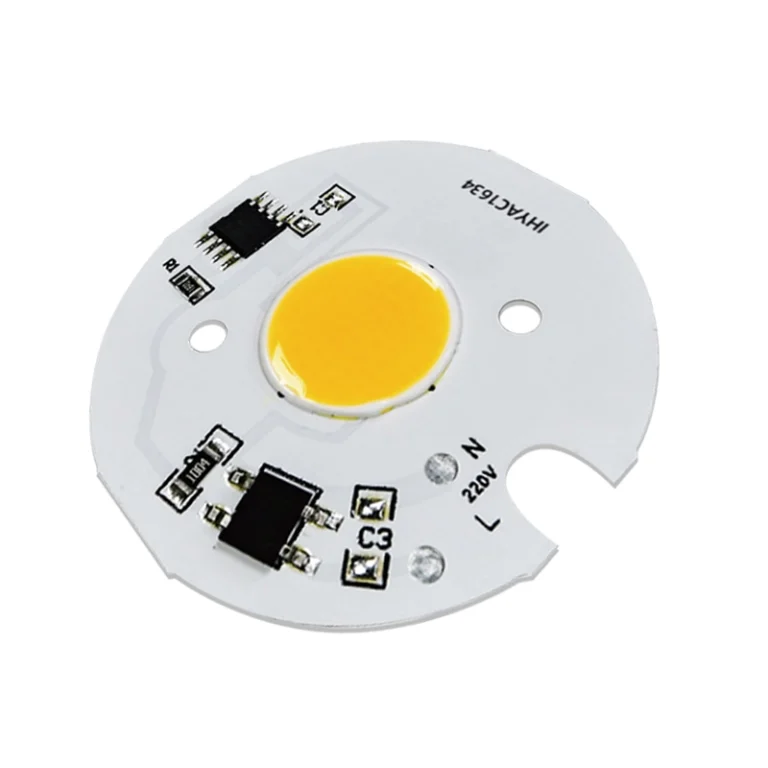
Projects requiring customized infrared light sources can review available IR & UV COB LED solutions as a starting point for matching wavelength, emitting structure, and module configuration to the equipment.
How to Compare 850nm and 940nm IR LED Performance Fairly
Electrical power alone is not a reliable way to compare two infrared light sources. A “5W” description, for example, does not directly describe how much useful IR reaches the target or camera.
Compare Radiant Flux, Radiant Intensity, Beam Angle, and Distance Together
Total emitted optical power is described by radiant flux, while the concentration of that output into a particular angle is described by radiant intensity. The distribution of available power across the scene is governed by beam geometry.
For a wide field camera, a narrow high intensity beam may create hotspots and dark edges. For a long distance detection task, a very wide beam may spread the available IR too broadly.
When comparing products, buyers should confirm the measurement conditions behind optical specifications and relate them to the required field of view and working distance.
Compare Both Wavelengths Under Equivalent Conditions
For a meaningful comparison of 850nm and 940nm, the same camera, lens, exposure, distance, target, and ambient environment should be used wherever possible. If one sensor is used for the 850nm test and another for the 940nm test, the result tells little about wavelength alone. The same holds for comparisons of products with differing beam angles or drive conditions.
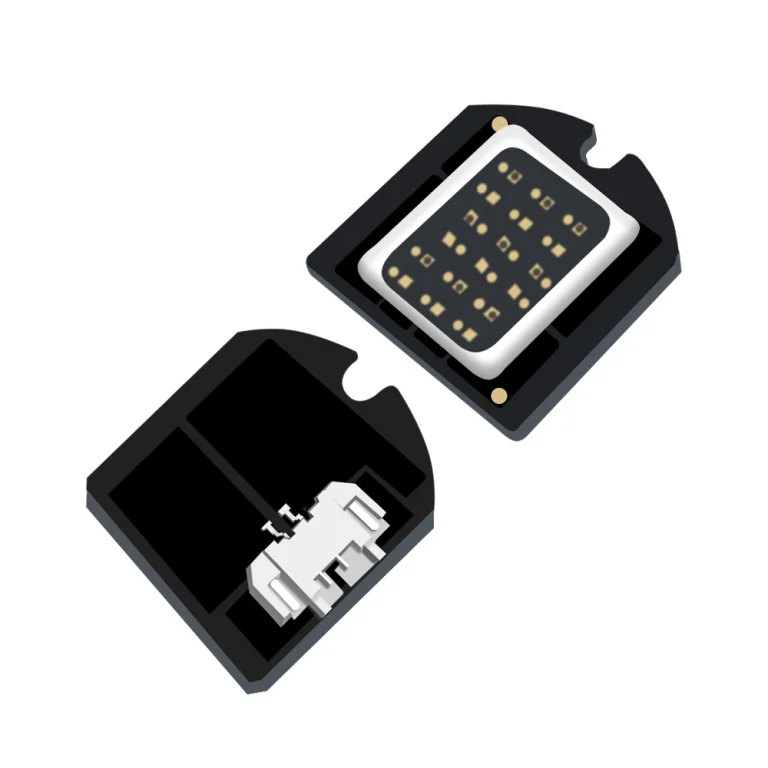
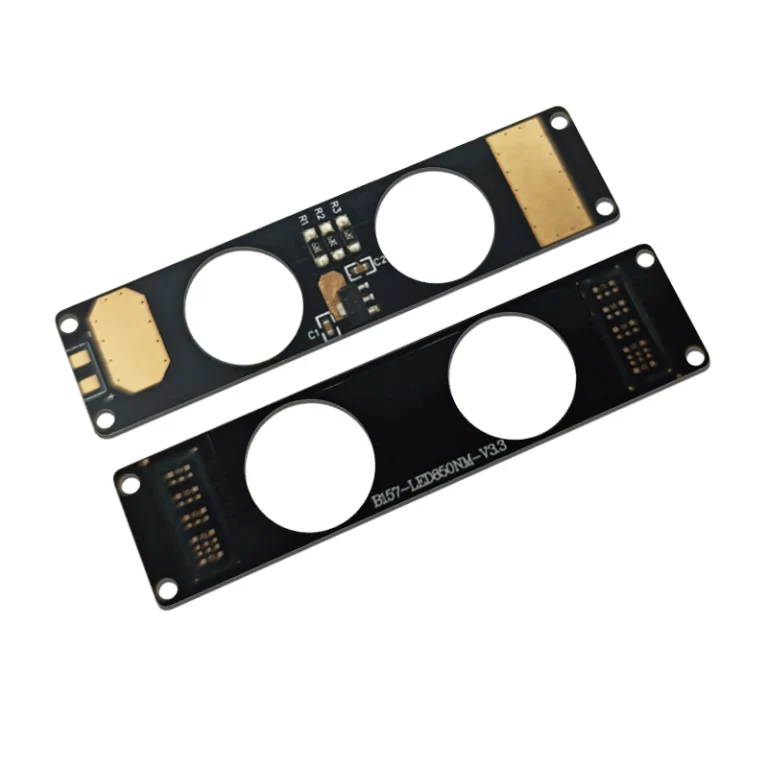
An existing 850nm and 940nm IR LED module can be useful as a reference point when defining wavelength, electrical, mechanical, and module level requirements for an OEM design.
Can a 940nm IR LED Replace an 850nm LED?
Changing wavelength is often a redesign decision rather than a simple component substitution.
Check Sensor, Optical, Electrical, and Thermal Compatibility
First, verify sensor compatibility: does the camera maintain adequate response at 940nm?
Next, check optical compatibility. The lens, filter, beam angle, and field of view must still work with the new source.
Electrical compatibility matters as well. Voltage, current, driver limits, and control method should be compared against the replacement specification.
Finally, check thermal performance. If a different drive level is required to obtain the same detected signal, the heat load may change.
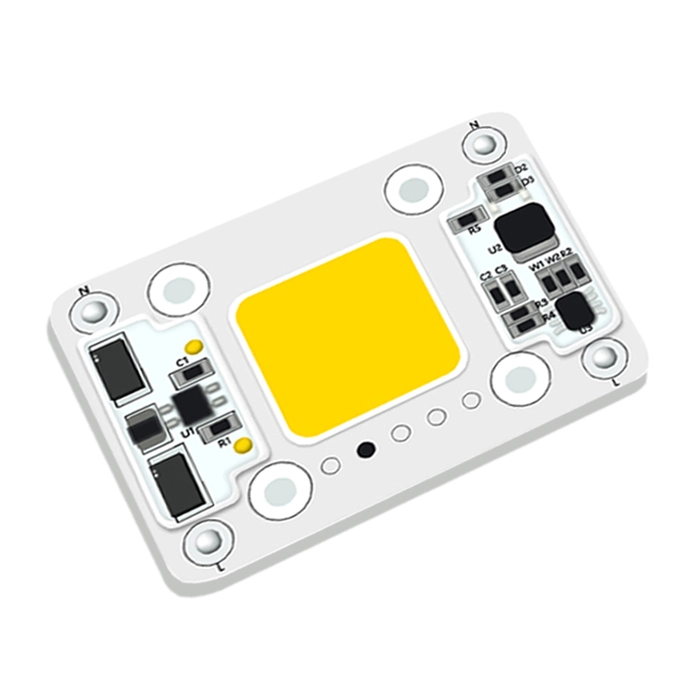
A technically successful replacement should therefore pass image quality and thermal validation under the product’s real operating conditions. Engineers evaluating higher power infrared architectures may also review a high power IR COB design case study to see how wavelength choice interacts with light source configuration.
How OEM Buyers Should Specify an 850nm or 940nm IR LED Module
Once the wavelength direction is clear, supplier selection should focus on whether the proposed module fits the complete system rather than whether the supplier can simply provide an 850nm or 940nm emitter.
Put the Right Technical Requirements in the RFQ
A useful RFQ should include:
- Required wavelength and acceptable wavelength tolerance
- Camera or sensor model
- Target working distance
- Field of view or illumination area
- Radiantoutput requirement
- Beam angle
- Input voltage and current
- Available module dimensions
- PCB or substrate constraints
- Thermal environment
- Mounting or connector requirements
- Existing module information for replacement projects
- Prototype and expected production quantities
Providing these inputs gives the supplier enough context to identify potential optical or mechanical conflicts early.
What to Check When Comparing IR LED Suppliers
A qualified supplier should be able to discuss the interaction between wavelength, sensor response, optics, electrical requirements, module geometry, and thermal conditions.
IHYLight publicly offers IR COB and IR LED module options, including products covering 850nm and 940nm, as well as customized light source configurations. That makes the relevant evaluation question whether the available or custom architecture fits the specific camera, sensing, and mechanical requirements not simply whether the wavelength exists in a catalog.
Conclusion
The choice between 850nm and 940nm IR LEDs ought to begin with the detector and the application. When camera response and detected signal are key, an 850nm source is often a solid option; whereas 940nm may appeal when less visible red glow is important. Still, the final selection hinges on the sensor, lens, filters, working range, beam angle, ambient conditions, electrical design, and thermal path.
For OEM sourcing or replacement projects, IHYLight can be evaluated using those same criteria. An OEM IR LED project can be discussed by a project team by supplying the current module or model, size, sensor data, operational conditions, drawing, desired wavelength, target quantity, application specifics, or photos of an existing installation or fault scenario.
FAQs
Which is better for night vision, 850nm or 940nm?
850nm is often considered when camera response and image signal are the main priorities. A 940nm IR LED may be preferred when reduced visible red glow is more important. The camera sensor and optical system should be checked before deciding.
Can a camera see 940nm infrared light?
Many cameras can detect 940nm infrared, but sensitivity varies by sensor, lens, and filter. The sensor spectral response curve and optical path transmission should be verified.
Why does an 850nm IR LED show a red glow?
850nm is closer to the visible light spectrum than 940nm, so some residual red emission can be more noticeable. The exact visibility depends on the emitter and operating conditions.
Does 940nm IR have a shorter range than 850nm?
Not necessarily in every system. Working distance depends on sensor response, radiant intensity, beam angle, optics, exposure, target reflectivity, and ambient conditions. Range should be tested with the actual camera system.
Can I replace an 850nm IR LED with a 940nm LED?
Possibly, but it should not be regarded as only a direct wavelength substitution. Sensor response, lens and filter transmission, electrical requirements, beam geometry, and thermal performance all need checking prior to replacement.