



IEC 62031:2026 brings a technical revision to the international safety requirements for LED modules requirements that OEM engineers, equipment manufacturers, compliance teams, and technical buyers depend on. Published on February 23, 2026, the third edition replaces IEC 62031:2018 and updates a wide range of areas, from scope and marking to electrical, thermal, mechanical, photobiological, and abnormal condition safety requirements.
For an OEM that already has an LED module design, the practical question isn’t just what changed in IEC 62031:2026. It’s whether those changes affect the module architecture, validation evidence, product documentation, or supplier qualification process before design approval and mass production.
Does IEC 62031:2026 Apply to Your LED Module?
Before comparing IEC 62031:2018 vs 2026, engineers should establish whether the product is actually within the standard’s scope. This prevents unnecessary testing and, more importantly, avoids applying the wrong safety framework to a product.
IEC 62031:2026 covers safety requirements for LED modules operating on DC supplies up to 1,500 V or AC supplies up to 1,000 V. It does not specify LED module performance characteristics. The IEC also excludes LED packages, automotive lighting LED modules, OLED modules, and LED lamps from the standard.
Check the Module Architecture Before Applying the Standard
The first step is to define what the purchased assembly actually includes. An LED board, an integrated module, and a more complete light engine can place different electrical and system functions inside the supplier’s scope.
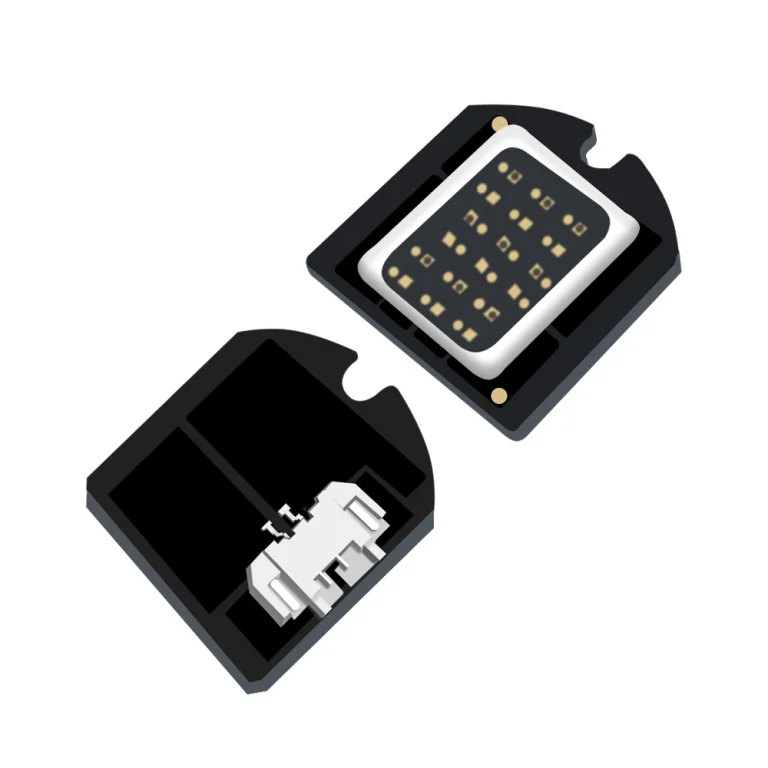
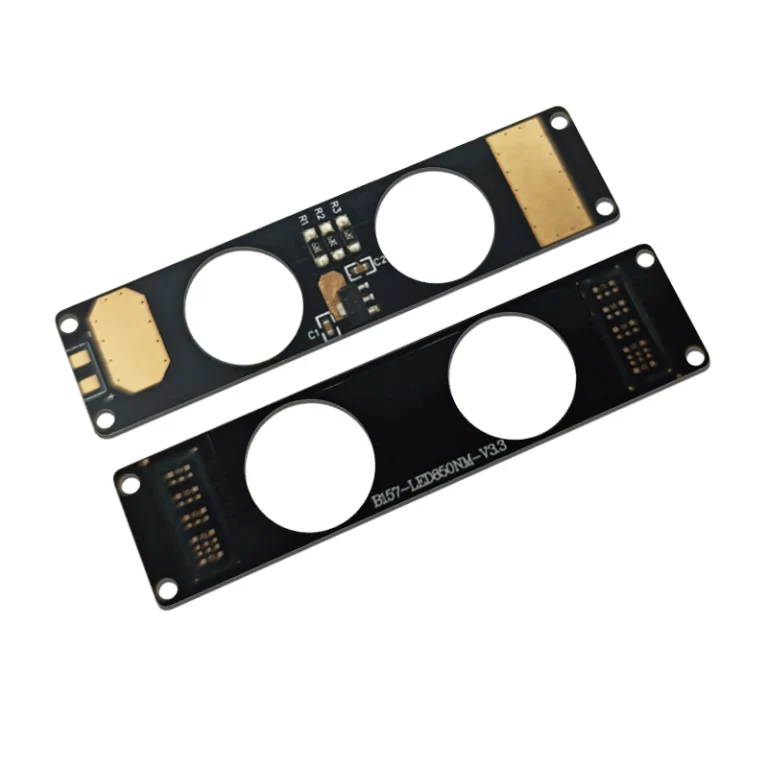
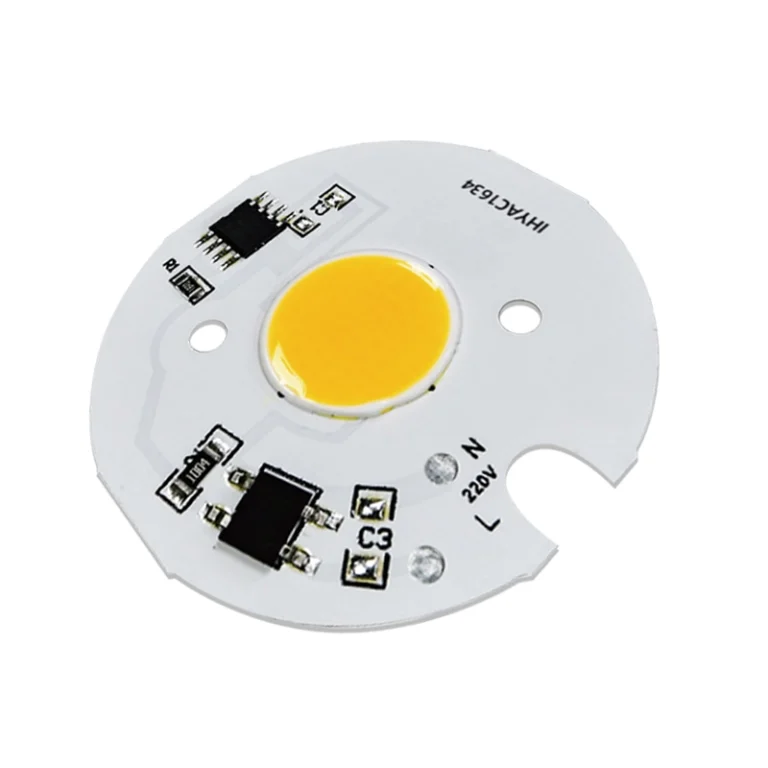
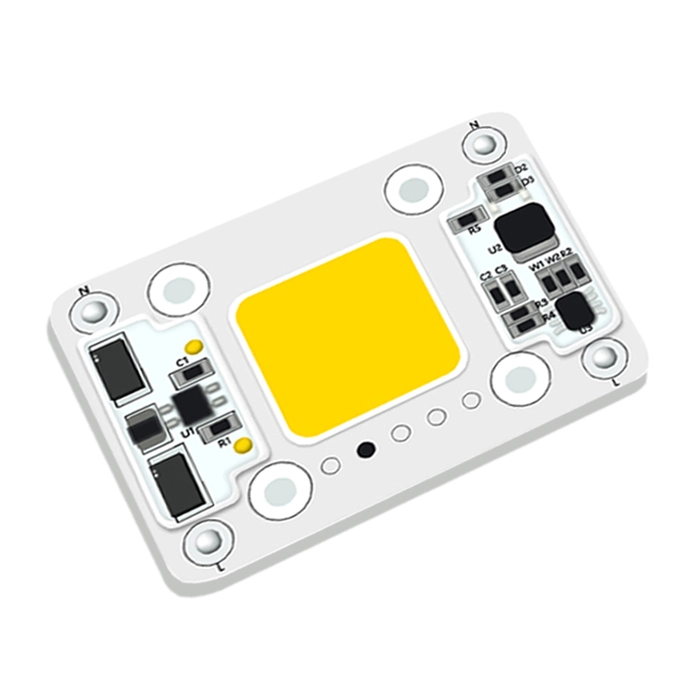
Before design validation, document the light source, PCB, power input arrangement, integrated electronics, connectors, controls, and other functions supplied as part of the module. If the product definition is unclear, reviewing the LED module and light engine architecture can help establish the supply boundary before compliance requirements are assigned.
This distinction matters during procurement as well. A suppliers description of a product, as an “integrated module” does not by itself show which safety related functions are included. Buyers should look at drawings, input specifications, connection details and the actual product setup. They should not rely on the words used. It is better to check the configuration and data to understand what the product does.
Know What IEC 62031:2026 Does Not Cover
Scope mistakes can create expensive validation detours. IEC 62031:2026 should not be treated as a general performance standard for every LED based product, nor should it be assumed to govern automotive LED modules simply because they contain LEDs.
An OEM investigating lumen maintenance, efficiency, color performance, or complete luminaire safety may need other requirements in addition to IEC 62031. The appropriate standards depend on the final product, target market, product architecture, and certification route.
The purchasing implication is straightforward: confirm what compliance claim is being made, which product level it applies to, and whether the quoted module is actually within that scope.
IEC 62031:2018 vs 2026: What Actually Changed?
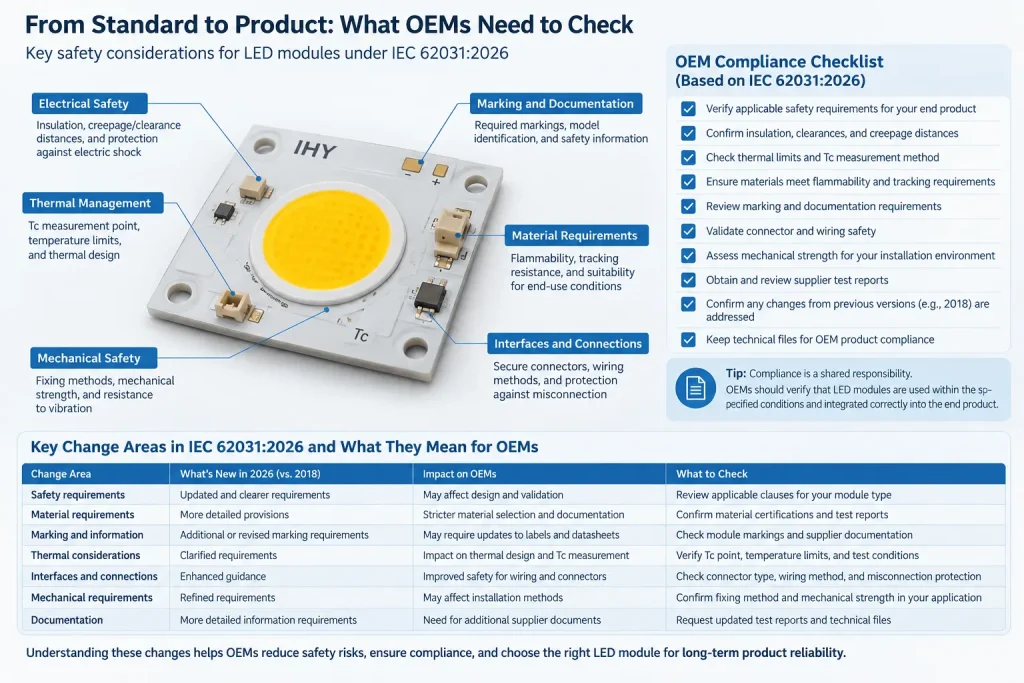
The 2026 edition is not only an editorial update. IEC describes it as a technical revision and identifies nine significant areas of change. For OEM teams, these changes are most useful when translated into design review actions rather than treated as a clause by clause summary.
| 2026 Change Area | What OEM Teams Should Recheck |
| Overall structure, technical requirements, and tests | Existing validation plans and referenced test requirements |
| Scope and applicability | Whether the module classification and architecture remain correctly assessed |
| Terms and definitions | Drawings, specifications, reports, and internal terminology |
| General and test requirements | Validation procedures and supporting evidence |
| Marking requirements | Module markings, control terminals, and related documentation |
| Electrical safety | Electrical construction and previous safety evidence |
| Thermal and mechanical safety | Thermal path, construction, mounting, and relevant validation |
| Photobiological safety | Applicable optical safety documentation |
| Fault and abnormal conditions | Existing abnormal operation and fault condition review |
Scope, Test Requirements, and Marking: What Should Be Rechecked?
For an existing product, begin with documentation that was created around the 2018 edition. Check the standard edition referenced in test reports, technical files, controlled drawings, labels, and internal validation procedures.
The 2026 revision clarifies scope and applicability, updates terminology, makes general and test requirements clearer, and revises marking requirements, including marking related to control terminals.
That does not mean every existing marking or report is automatically unacceptable. It means the OEM should compare the current product configuration and documentation against the applicable 2026 requirements rather than assuming that a previous review remains sufficient.
A useful purchasing question is: Which edition of IEC 62031 is referenced by the suppliers supporting documentation? Does that documentation cover the exact module revision being quoted?
Electrical, Thermal, Mechanical, and Photobiological Safety: Where Is the Risk?
The IEC says that electrical safety, Thermal safety and Mechanical safety requirements had a review and update. The update is meant to make things clearer and stop people from misunderstanding. Photobiological safety and fault or abnormal condition requirements were also revised.
For an OEM, this creates several review points. Electrical changes may affect how the module’s construction and connections are assessed. Thermal and mechanical requirements may affect how mounting, heat paths, or construction details are documented and validated. Optical safety evidence should be checked where photobiological requirements apply.
These reviews should remain focused on safety compliance. Detailed driver sizing, heatsink selection, optical design, and system compatibility are separate engineering topics. For those decisions, an LED module compatibility checklist can be used alongside the standards review rather than turning IEC 62031 into a general module selection guide.
Does an Existing IEC 62031:2018 Design Need to Be Rechecked?
A new edition alone doesn’t justify saying that every existing module has to be completely redesigned or retested. The work that must be done depends on the existing report, the certification route, the target market, the model scope, product changes and the exact requirements set by the certification body or laboratory. Each of these factors plays a role, in determining the next steps.
When Should a 2018-Based Product Trigger a Compliance Review?
A structured review is particularly useful when an existing test report references IEC 62031:2018, or when the module has changed since the original evaluation.
Possible review triggers include changes to the PCB, electrical components, terminals, module architecture, thermal construction, materials, markings, or controlled documentation. A supplier change or uncertainty about which models are covered by an existing report can also justify closer examination.
The goal is not to order unnecessary testing. It is to identify whether the evidence supporting the current product still corresponds to the product being manufactured or purchased.
For each affected item, compare:
Requirement → Current Product Evidence → Product Change → Review Owner → Required Action
The final decision on transition or retesting should be confirmed for the intended market and certification route rather than inferred from the publication date alone.
What Should OEM Buyers Request From an LED Module Supplier?
For technical procurement, the phrase “IEC 62031 compliant LED module” is not sufficient by itself. Supplier qualification should establish what product was evaluated, against which edition, and whether the evidence matches the module being quoted.
Buyers reviewing LED modules for OEM applications should request enough controlled information to identify the product clearly. Depending on the project, useful documentation may include the exact model designation, applicable standard edition, electrical ratings, controlled drawing, connection information, markings, installation information, revision identification, and relevant test or conformity documentation.
Documents and Red Flags to Check Before Supplier Approval
A compliance claim becomes difficult to evaluate when the supplier cannot identify the applicable edition, when supporting documents refer to another model, or when a drawing revision does not match the production configuration.
Other warning signs include unclear model family coverage, undocumented changes to safety relevant components, missing input or terminal information, or a generic certificate presented without a clear connection to the purchased module.
Technical buyers should therefore ask:
- Which exact model or model family does the supporting document cover?
- Which edition of IEC 62031 is referenced?
- Does the current drawing revision match the evaluated configuration?
- Have safetyrelevant design changes occurred since that evaluation?
- What information should the OEM provide for the final application review?
IHY Lighting publicly supplies DC, AC, UV/IR, cinematic and studio LED module categories and also develops integrated module and custom light engine configurations. Its custom COB LED solutions include work across structural, optical, electrical, and integrated module requirements, making the product architecture and supply boundary important information to establish before a custom project is evaluated.
This does not establish that any specific IHY product is certified to IEC 62031:2026. Product level compliance and supporting documents should be verified for the exact model and project requirement.
How Can OEMs Reduce IEC 62031 Compliance Risk Before Mass Production?
Compliance problems are less expensive to address before PCB layouts, tooling, markings, and production documentation become fixed.
Build Safety Requirements Into Design Validation and Change Control
At the beginning of a project, define the module architecture, applicable standards, target market, product specifications, and required supplier evidence. Then connect those requirements to the design validation plan.
After validation, create clear triggers for technical review. Changes to PCB construction, power components, terminals, insulation or mechanical materials, thermal interfaces, markings, or module architecture should not pass into production simply because the module still functions electrically.
IHY Lighting’s existing LED modules for OEM applications cover multiple electrical and application configurations, so buyers should verify the specification of the selected module rather than generalizing from another product in the same category. When a standard product does not fit the equipment using an LED module compatibility checklist can help clarify the needs, optical performance, thermal management and mechanical specifications. This guidance makes it easier to decide whether to request a replacement or go with a custom design.
Conclusion
IEC 62031:2026 gives OEM engineers a reason to revisit assumptions carried over from the 2018 edition. The useful approach is to confirm whether the standard applies map the nine revision areas to the existing design review current evidence and verify that supplier documentation corresponds to the actual module being purchased.
For a new, replacement, or custom LED module project, useful RFQ inputs include the application, drawings, available dimensions, electrical conditions, operating environment, required module architecture, target market, current sample or model information, and expected quantity. Relevant compliance documentation should be specified separately rather than assumed from a product description.
For projects that need a check buyers should get in touch with IHY Lighting. They should share the drawings. They should also provide the application needs. They should include any existing module details. They should mention the compliance goals. This way the product setup and any missing technical details can be found out. This should happen before making samples or approving production.
FAQs
What is the latest version of IEC 62031?
IEC 62031:2026, Edition 3.0, was published on February 23, 2026. It replaces IEC 62031:2018 and is identified by IEC as a technical revision.
Does IEC 62031 cover LED module performance?
No. IEC 62031:2026 addresses LED module safety requirements and explicitly states that LED module performance characteristics are outside its scope.
Does IEC 62031:2026 apply to automotive LED modules?
No. LED modules for automotive lighting are explicitly excluded from the scope of IEC 62031:2026. Automotive projects should be assessed against the requirements applicable to the specific product and target market.
How can an OEM verify an IEC 62031 compliant LED module supplier?
Ask which edition applies, which exact models are covered, whether the supporting documents correspond to the current drawing revision, and whether safety relevant changes have occurred since evaluation. A generic compliance statement should not replace product specific technical evidence.