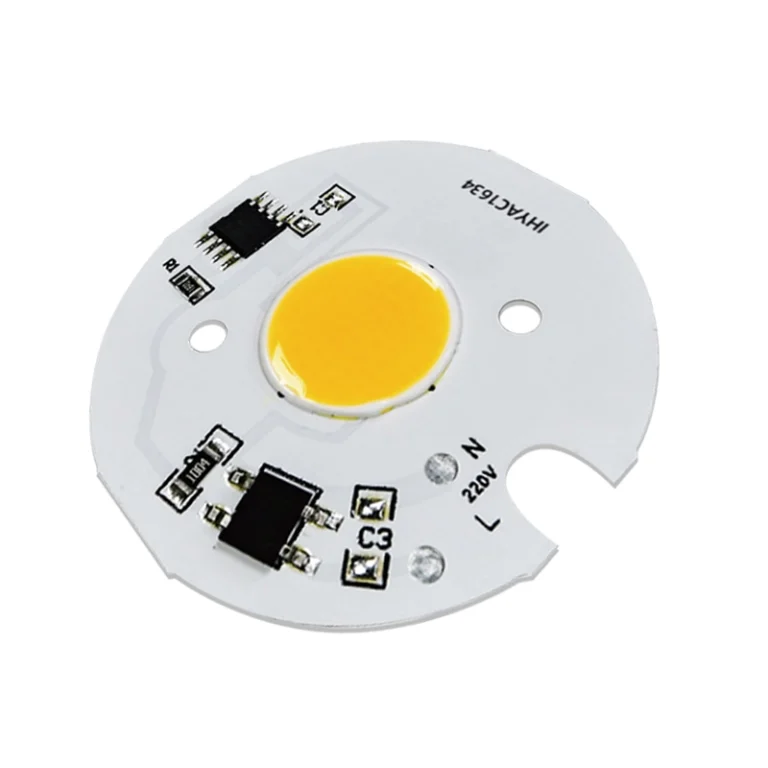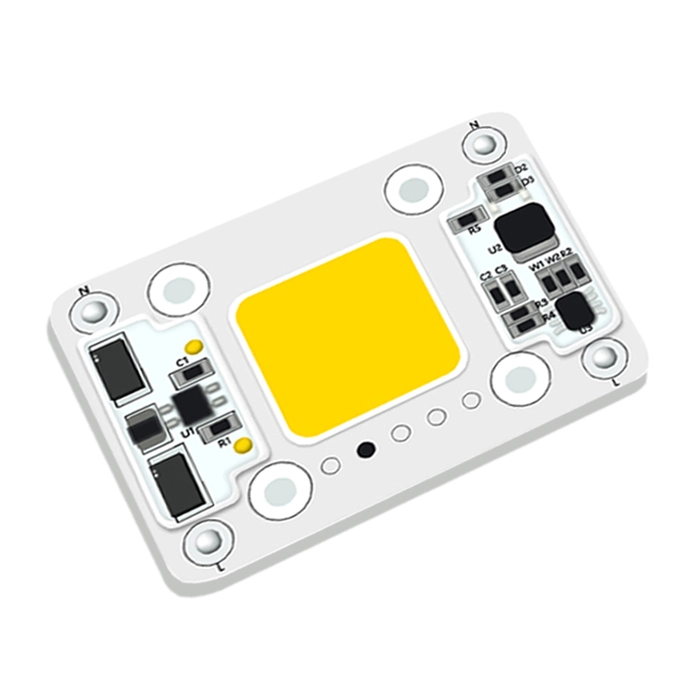




The dispensing process plays a crucial role in the spatial distribution of the correlated color temperature of COB leds (Chip On Board). The following is a detailed analysis of its influence on the spatial distribution of the correlated color temperature of COB leds:
Uniformity: If the amount of dispensing is uneven, the heat dissipation performance of the COB LED chip will vary. Specifically, when too much glue is applied in certain areas, the heat conduction path in that area will be blocked, making it difficult for heat to dissipate, thereby causing a local temperature increase. In areas where there is too little dispensing, due to the lack of sufficient heat conduction medium, the heat generated by the chip cannot be transferred to the outside of the package in time, thereby causing changes in the temperature distribution of each area. This temperature difference will eventually affect the spatial distribution of the relevant color temperature, causing deviations in the color temperature of different regions.
Accuracy: Whether the amount of dispensing is too much or too little, it will affect the optical performance of the LED chip, resulting in inconsistent color temperatures. For instance, excessive dispensing may block some of the light, resulting in uneven brightness. In practical use, excessive glue may result in irregular thickness of the glue layer. When light passes through these areas, it will refract and scatter to varying degrees, thereby causing changes in the light emission Angle and light intensity distribution, and further disrupting the consistency of color temperature.
Deviation situation: If the dispensing position deviates significantly from the center position of the LED chip, it will cause uneven light scattering. When the dispensing position deviates from the center, the originally symmetrical optical system is disrupted, resulting in the inability of light emitted from all directions to mix evenly. Especially near the edges, due to the lack of sufficient glue support or the accumulation of excess glue, it will cause changes in the light propagation path, affecting the uniform distribution of the relevant color temperature.
Consistency issue: During mass production, minor deviations in the dispensing position accumulate continuously, which can significantly affect the relevant color temperature of COB leds. Even a very small positional offset can lead to a gradual increase in the differences between products throughout the production batch. Over time, these subtle differences will have a negative impact on the overall product quality and reduce product consistency.
Optical performance: The optical properties of dispensing materials, such as refractive index and light transmittance, are directly related to the light output of COB leds. Different types of glue have their own unique physical and chemical properties. For instance, the higher the refractive index, the easier it is for light to be bent. And vice versa. Selecting appropriate materials can effectively control the number of internal reflections and the lost energy, thereby enhancing the luminescence efficiency and indirectly affecting the relevant color temperature distribution.
Thermal performance: The thermal conductivity of the dispensing material will affect the heat dissipation of the LED chip. Good thermal conductivity helps to quickly conduct heat out of the chip surface, reducing the chance of hot spot formation. On the contrary, if inferior or mismatched materials are selected, it may lead to local overheating, which not only shortens the lifespan of the device but also has an adverse effect on the uniformity of the relevant color temperature.
Temperature control: The temperature control during the dispensing process directly affects the curing effect of the dispensing material. Operating at excessively high ambient temperatures can easily accelerate chemical reactions, causing the glue to harden prematurely or even deteriorate. However, if it is too low, it prolongs the curing time and increases the uncertainties in the production process. The ideal working conditions should be maintained within a relatively stable range to ensure that each step proceeds as expected.
Temperature stability: Temperature fluctuations can cause uneven curing of dispensing materials. Even minor changes may cause problems such as a decrease in viscosity or the formation of bubbles, which is unacceptable for precision assembly. To ensure the quality of the finished products, it is necessary to strictly control the environmental parameters in the workshop to avoid potential risks brought by external interference.
In terms of precision: High-precision automated dispensing equipment can ensure that the dispensing volume and dispensing position are precisely controlled. After setting the parameters through programming, the machine can repeatedly perform tasks without feeling fatigued, which greatly improves the accuracy of the operation. In addition, variables such as the injection speed and pressure size can be adjusted as needed to flexibly deal with various complex situations and ensure the uniform distribution of the relevant color temperature of COB leds.
In terms of consistency: In mass production, the consistency of the automated dispensing process directly determines the quality of COB LED products, including the consistency of related color temperatures. The adoption of an advanced control system enables multiple robotic arms to operate synchronously. Each product must go through a strict inspection process before entering the next procedure. In this way, not only is the manufacturing efficiency improved, but also it is ensured that all the products leaving the factory can meet the same high standards.
Stability impact: The dispensing process directly determines the stability of the COB LED packaging structure. A stable physical form is one of the bases for ensuring the normal operation of electronic components. Once there is any loosening or other form of change, it will bring hidden dangers to subsequent use. For instance, it is more prone to damage when subjected to external force impacts, or may fall off due to aging after long-term operation, etc. Therefore, it is particularly important to find a reliable way to fix each component.
Sealing performance impact: The sealing performance of dispensing materials is related to the service life of LED chips. High-quality sealants can prevent moisture from entering the internal circuits and avoid short-circuit faults. Meanwhile, it can also prevent dust and other contaminants from adhering to the surface, thus extending the maintenance cycle of the equipment. All of this is to ensure that the product can maintain good performance under harsh conditions, which indirectly affects the long-term stability of the related color temperature.
Heat dissipation optimization: The dispensing process can optimize the heat dissipation path and enhance the heat dissipation efficiency of LED chips. Reasonable design of the pattern shape and size can help heat be conducted to the shell or other cooling devices more efficiently. In addition, appropriately increasing the contact area can also promote energy exchange between the two sides, further improving the overall cooling effect and ensuring the stability of the relevant color temperature.
Thermal management consistency: The consistent performance of the dispensing process ensures the consistent thermal management of COB leds, thereby guaranteeing the uniform distribution of relevant color temperatures. Only when every link is precise and error-free can this goal be truly achieved. To this end, it is necessary to establish a complete quality management system, covering multiple links such as raw material inspection and production processing monitoring, to ensure that a high level of operation can be maintained from beginning to end.
Uniformity of light output: The dispensing process optimizes light scattering, enhancing the uniformity of light output and thereby affecting the distribution of related color temperatures. By controlling the thickness of the coating and the surface roughness, the emitted photons can be more concentrated in propagating forward, reducing unnecessary losses. This approach not only enhances the visual experience but also improves the color reproduction, meeting the high demands of professional fields for image quality.
Optical performance stability: The stability of the dispensing process directly affects the optical performance stability of COB leds, including the long-term stability of correlated color temperature. The continuous provision of high-quality services relies on strictly adhering to established procedures and technical specifications. Any deviation may disrupt the original balance state and cause inconvenience to users. Therefore, in daily operations, it is necessary to continuously enhance the intensity of training, improve the sense of responsibility and technical proficiency of employees, and jointly maintain the brand image.
Precision impact: The precision of the dispensing process directly affects the quality control of COB leds and is related to the uniformity of color temperature. The truth is revealed in the details. The simpler the steps seem, the more seriously they need to be taken. The position of each drop must be accurate and error-free; otherwise, even a slight deviation will accumulate and form obvious defects. Therefore, it is of vital importance to cultivate a technical team that is experienced and meticulous.
Efficiency impact: The automated dispensing process enhances production efficiency and ensures the consistency of COB LED product quality, including the uniform distribution of related color temperatures. After introducing intelligent devices to replace manual operations, the originally time-consuming and laborious work has become much easier and faster. Moreover, due to the reduction of the possibility of human error, the qualified rate of finished products has been greatly improved. This is of great significance for large-scale commercial applications.
Adaptability: The dispensing process optimizes the performance of COB leds, making them suitable for various application fields, especially those with high requirements for relevant color temperatures. In the face of diverse market demands, manufacturers must constantly innovate and improve formulas and technical means, striving to make their products have broader compatibility. Only in this way can we seize more business opportunities and stand out in the highly competitive market environment.
Reliability: The reliability of the dispensing process directly affects the reliability of COB leds in various application fields, including the stability of correlated color temperatures. Users always hope to purchase goods that are both economical and durable. In order to win the trust and support of consumers, enterprises need to invest more resources in the research and development, testing of new products, new technologies, new models and other aspects of work to continuously enhance their comprehensive strength level and meet the growing social demand standards. In conclusion, the impact of the dispensing process on the spatial distribution of the correlated color temperature of COB leds is all-round. From the control of dispensing volume, position accuracy, material selection, temperature management, degree of automation, the influence of packaging structure, thermal management, optical performance to quality control and adaptation and reliability in application fields, each link may affect the uniform distribution of the correlated color temperature of COB leds. Therefore, optimizing the dispensing process is the key to ensuring the uniform spatial distribution of the related color temperature of COB leds.