





Flexible COB LED Strips: Design and Installation Guide
Introduction
Flexible COB LED strips are used a lot in lighting. They are also used in displays. They are used in lighting. They are used in electronic products. The way they light up looks continuous. Their structure can bend. This makes them good for places where regular stiff LED boards would not work.
However selecting a flexible COB LED strip requires more than just looking at brightness and dimensions. A flexible COB LED strip can also be affected by bend radius, substrate materials, electrical performance, heat dissipation and installation conditions. All of these factors influence the result.
This guide explains the key factors that OEM manufacturers, lighting designers, and product developers should consider when choosing flexible COB LED strips.
What Is a Flexible COB LED Strip?
COB means Chip on Board. In a COB LED strip many LED chips are placed together on a liner substrate forming a surface that glows almost continuously.
A flexible COB LED strip is usually made on a printed circuit board or on another flexible material that works well. The design of a COB LED strip lets the strip bend around curves and still stay compact and bright. A flexible COB LED strip can follow the shape of a surface while keeping a small lighting profile.
Compared with strips that use individually packaged LEDs COB designs can give a line of light that looks more even. The real look depends on how apart the chips are, how they are covered, how far the line is placed and the light treating qualities of the materials around it.
Flexible COB LED strips are suitable for many lighting designs, but their flexibility has mechanical limits. The complete assembly must be installed according to the manufacturer’s specifications.
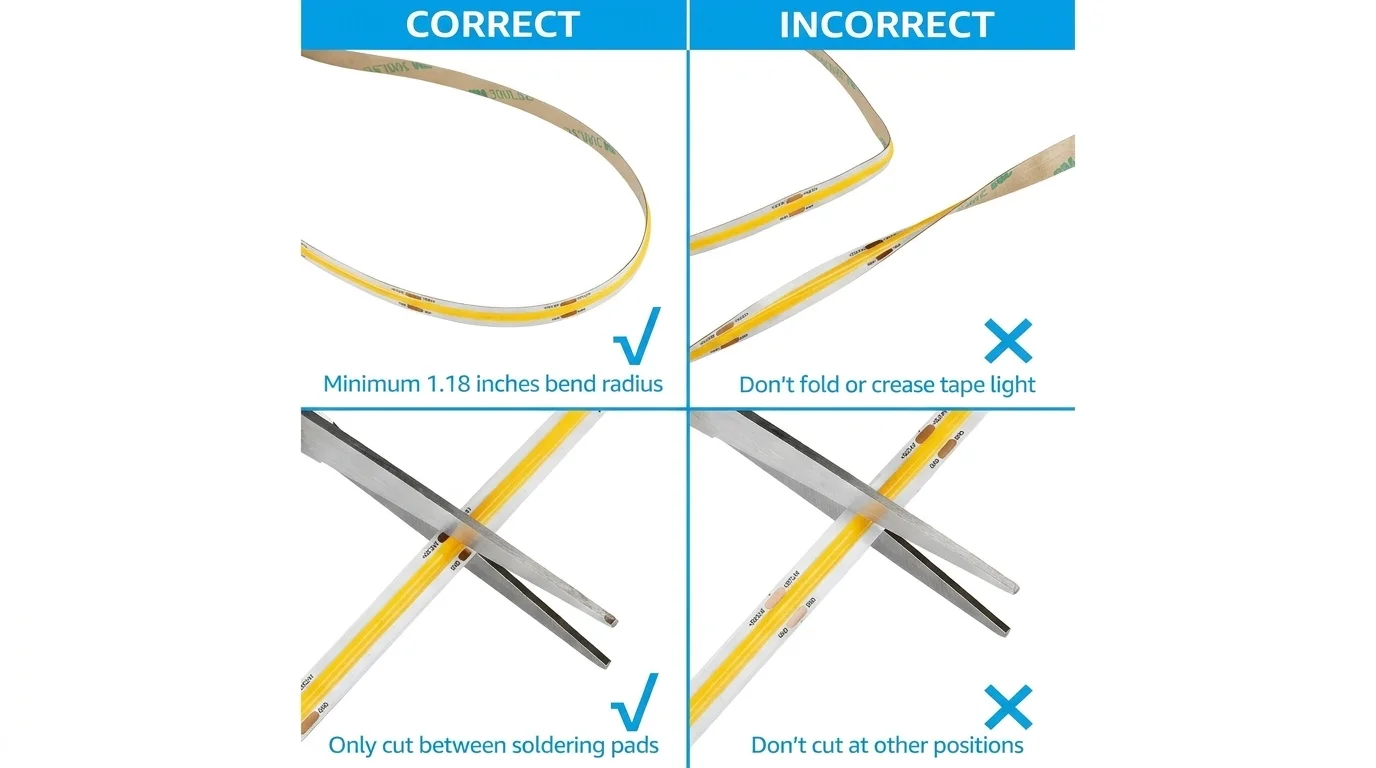
- Understand the Minimum Bending Radius
The bending radius is the size of the curve when a strip is bent. A smaller bending radius means the curve is tighter. This usually leads to mechanical stress in the material.
Before installing make sure to check the bending radius that the manufacturer has specified. If you bend the strip more than what’s suggested it could harm the conductive traces the solder joints or other parts.
It is also important to differentiate bending from dynamic bending. Static bending happens when a strip is placed in a fixed spot. Dynamic bending happens when the strip moves back and forth times, which adds more fatigue risk.
Flexibility, in one direction doesn’t mean the strip can bend or twist in all directions. When dealing with three-dimensional shapes a specially designed circuit or mounting structure might be needed.
- Choose the Appropriate Substrate
The substrate plays a role in mechanical flexibility, electrical resistance and thermal performance. Flexible printed circuit boards are often used in LED strips because they allow for controlled bending without damage. Choosing the right copper thickness, circuit layout, strip width and substrate material is important. These choices must match the load and mechanical needs of the application.
A thinner base is not always better. The design needs to offer ability to carry current and last a long time physically.
For uses where more cooling is needed the strip might have to be placed on a support or something that moves heat away. The way it is put in place should not add much physical pressure or hurt the way it is meant to move.
- Consider Electrical Performance
Electrical design matters a lot when you put flexible COB LED strips over distances.
Conductors have resistance so voltage can get lower along the strip as current moves, through it. Much voltage drop can cause the brightness to look different in different parts. This depends on how the circuit’s set up and the conditions it works under.
When selecting a strip, consider these factors:
- Operating voltage: Match the LED strip to a compatible power supply or driver.
- Current capacity: Ensure that circuit traces, connectors, and wiring can safely carry the required current.
- Installation length: Evaluate voltage drop across the entire installation.
- Power distribution: Consider additional power-feed points where appropriate.
- Dimming compatibility: Confirm that the strip and control system support the intended dimming method.
Testing the complete installation helps verify electrical performance under actual operating conditions.
- Plan for Effective Thermal Management
LEDs generate heat during operation, and effective thermal management is essential for maintaining performance.
A flexible COB LED strip placed in an enclosed space might manage heat in a way, than one used in an open area. The way heat is released can change based on the type of adhesive used the presence of covers, nearby materials and how much air can move around. All these factors influence the operating temperature of the LED strip.
Designers should consider power consumption, ambient temperature, installation surface, and continuous operating time when evaluating thermal requirements.
For applications requiring sustained high output, a suitable thermal path should be incorporated into the product design. Prototype testing can help identify potential temperature-related problems before mass production.
- Select the Right Installation Method
Installation conditions shape both stability and long-term performance.
Adhesive backing can make installation easier on surfaces that work well with it. How well it works depends on how clean the surface’s what kind of material it is, the temperature and the environment.
For situations using mounting channels or extra mechanical holding might be the right choice. The method you pick should keep the strip in place without causing folds or too much pressure in one spot.
Environmental protection also needs thought. If the application involves moisture, dust, outdoor exposure or cleaning agents evaluate the protection requirements of the assembly including connectors and cable exits.
An IP rating applies to a tested configuration. An IP rating should not be assumed for the product without verification.
- How to Specify a Flexible COB LED Strip
A clear specification helps manufacturers assess feasibility and recommend suitable products.
Before contacting a supplier, prepare the following information:
- Application: Describe the intended product and lighting effect.
- Dimensions: Specify strip length, width, and available installation space.
- Bending requirements: Define bending direction, approximate radius, and whether movement is repeated.
- Electrical specifications: Provide operating voltage, power requirements, and connection details.
- Lighting requirements: Identify color temperature, brightness, and color rendering requirements.
- Environment: Specify expected temperatures and exposure to moisture, dust, or vibration.
- Production quantity: Indicate prototype needs and estimated production volume.
Drawings, photographs, and physical samples can help clarify complex requirements. For customized projects, prototype testing should evaluate mechanical fit, electrical behavior, thermal performance, and lighting appearance.
Flexible COB LED Solutions from IHY Lighting
IHY Lighting offers flexible led products along with IHY Lighting’s COB LED and LED module portfolio. The fit of a solution depends on the needed size, electrical details, light spread and where it will be installed.
For OEM and ODM projects giving requirements early can help IHY Lighting decide if an existing product will work or if a new design must be examined.
To look at lighting products and solutions go to the IHY Lighting website or talk to the team via the Contact Us page.
Conclusion
Flexible COB LED strips provide a lighting choice for surfaces and small areas. To use them properly you need to think about more than picking the right size of the strip. You need to check the bending radius, the way the material is built the voltage drop how it will be controlled and how the strip will be put in place. When you set the requirements and test samples in real situations manufacturers can make better decisions for their lighting projects.
For OEM product developers looking for lighting choices IHY Lighting offers a starting point, for looking into COB LED and custom LED module solutions.