



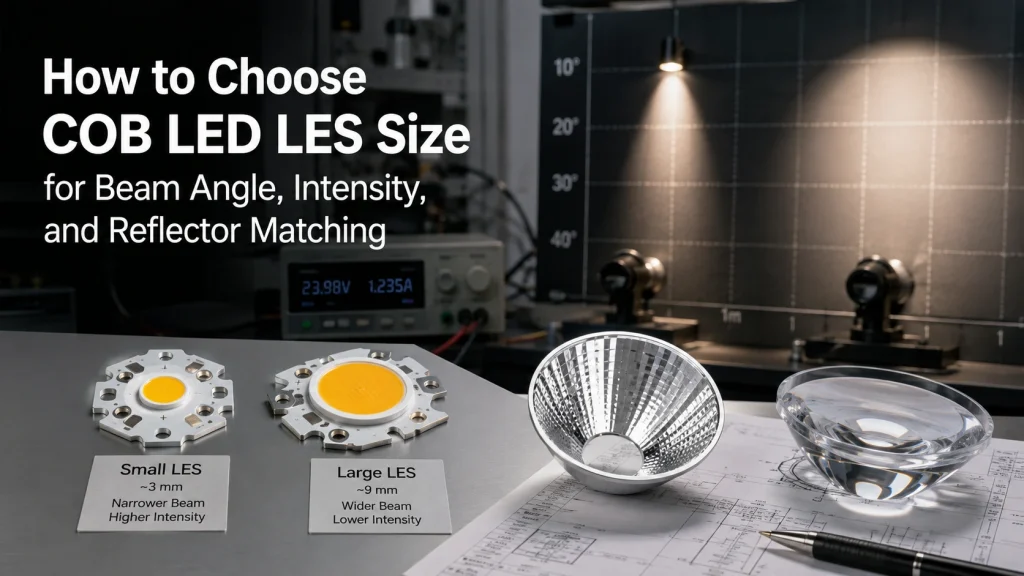
A replacement COB LED can have the same wattage and nearly the same PCB dimensions as the original yet produce a wider beam, lower center intensity, or different edge falloff. One common reason is COB LED LES size. The light emitting surface affects how closely the source behaves like a point source relative to a reflector or lens, so LES should be selected together with the target beam, optic size, focal position, working distance, and thermal limits.
For OEM engineers and technical buyers, the practical question is not whether a small LES is universally better. It is which emitting area size fits the optical system being designed or repaired.
What Is COB LED LES Size, and Why Is It Different From Package Size?
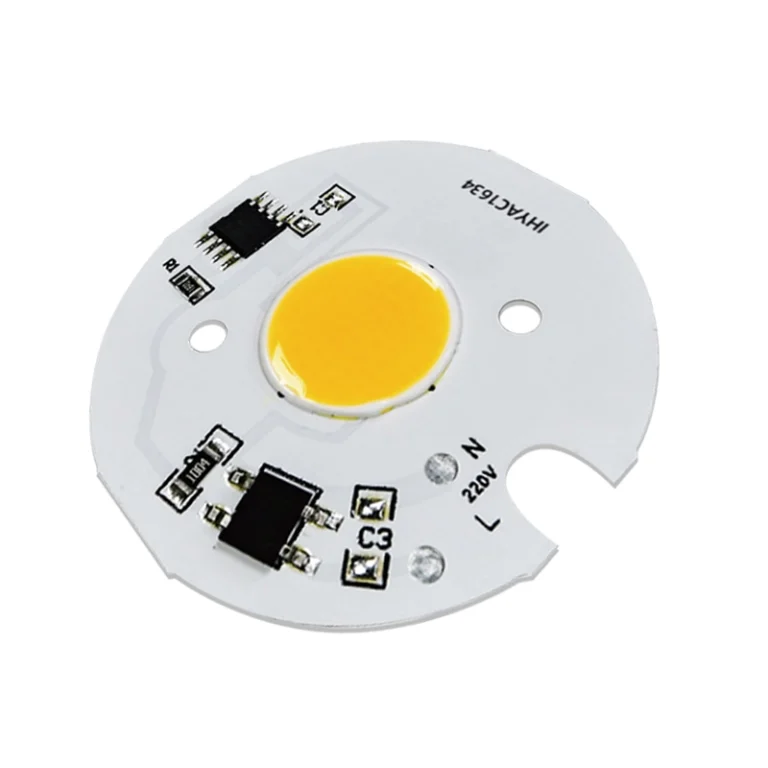
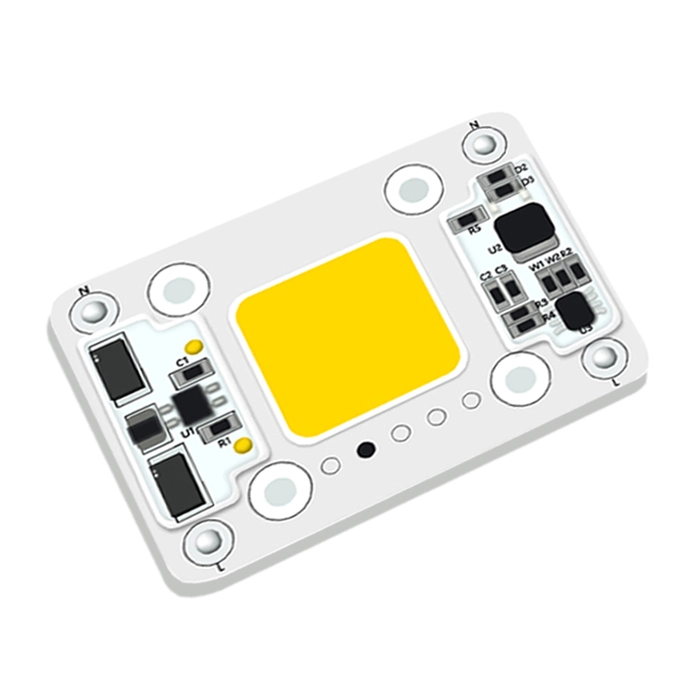
LES, or light emitting surface, describes the area from which useful light is emitted. It is not the same as the outside dimensions of the ceramic substrate, aluminum PCB, holder, or complete COB package.
This distinction matters because secondary optics interact with the luminous area and its position, not simply with the mounting board outline. IHY’s OEM module guidance likewise treats LES dimensions, focal position, beam profile, and optical compatibility as separate selection parameters.
LES Size vs PCB Size: What Must Be Checked Before Selecting or Replacing a COB
When comparing two COB LEDs, review both the mechanical drawing and the optical geometry. Check the LES diameter or dimensions, emitting surface shape, optical center, package height, mounting hole positions, and location of the emitting plane.
A replacement can fit the original holder while placing a larger luminous surface inside an optic designed for a smaller source. It may also position the emitting plane differently relative to the focal point. Either change can alter the finished beam even when voltage, power, and PCB dimensions appear compatible.
For replacement work, compare drawings rather than relying on product photos or nominal package size. The existing COB LED module replacement and optical compatibility guide can be used for the wider electrical, mechanical, thermal, and optical checks that should accompany an LES comparison.
How Does LES Size Affect Beam Angle and Center Intensity?
For a focused luminaire, total lumens do not tell the entire story. A fixture may need high candela on a distant target, a defined FWHM beam angle, or a specific illuminated diameter at a working distance.
The relationship between source size and secondary optics strongly affects those results.
Why a Smaller LES Can Produce a Tighter Beam With the Same Optic
A reflector or lens controls light most easily when the source is small relative to the optic. A real COB is not a mathematical point source: light originates from different positions across the LES. As the emitting area becomes larger, rays from its outer regions enter the optic from different positions and angles, increasing the angular spread of the finished beam.
With the same or comparable optic, a smaller LES can therefore make a narrow beam and higher center intensity easier to achieve. Small LES COB architectures are commonly associated with high intensity spot applications for this reason.
This does not mean that reducing LES automatically produces the required beam. Reflector diameter, lens geometry, source position, tolerances, and working distance still matter. If the optic itself cannot provide the required collimation, changing only the COB may not solve the problem.
When a Larger LES Is the Better Choice
A large light emitting surface should not be treated as an optical defect. Many products do not need maximum center candela.
Close-range fill lighting, broad area illumination, diffused systems, and applications that value field uniformity may benefit from a larger emitting area. The optical system may also have enough diameter and depth to accommodate the source without sacrificing the required distribution.
IHY’s existing module selection guidance notes the same trade off: smaller LES can support tighter beam control, while a larger emitting area may favor uniformity but can require a larger optical system.
The correct comparison is therefore not “small LES versus large LES” in isolation. Compare the required beam distribution, usable intensity, optical envelope, and target distance.
How to Match COB LED LES Size to a Reflector or Lens
An existing reflector or lens places practical limits on the LES that can be used. Commercial COB optics are often designed around specific emitting surface ranges; optical product families may pair larger optic diameters with larger supported LES sizes.
Check LES to Optic Ratio, Focal Position, and Working Distance Together
Start with the finished light requirement. Define the target beam angle or illuminated diameter, the distance from fixture to target, and whether center intensity, field uniformity, spill control, or edge transition is most important.
Then check the optical interface:
- LES diameter, dimensions, and shape
- reflector or lens aperture
- Emittingplane height and focal position
- mechanical centering and holder tolerance
- available optical depth and diameter
- target working distance
- required beam diameter or FWHM
- acceptable spill and edge falloff
Optics designed for one LES should not automatically be assumed compatible with another simply because both accept the same package mechanically. Practical COB optical examples show that optic diameter, LES size, and beam configuration are normally evaluated as a system.
For applications such as stage or focused lighting, matching COB LED LES size to reflectors and lenses provides additional context on LES, focal position, zoom systems, output, and fixture level optical validation.
When Changing the Optic Is Better Than Choosing a Smaller COB
If the existing COB already meets electrical, output, color, and thermal requirements, redesigning the source solely to narrow the beam may introduce unnecessary changes.
A larger or differently designed reflector or lens may sometimes provide the required optical control while allowing the existing source architecture to remain. Conversely, if the fixture diameter and optical depth cannot change, a smaller LES may be the more practical route.
The decision should compare both options at the system level. A very small LES that cannot deliver sufficient usable flux or that raises local power density beyond the available thermal architecture is not automatically preferable to a larger source paired with a better optic.
What Are the Trade Offs of a Small High Power LES?
Small LES designs are attractive for high intensity COB LED applications because they can concentrate substantial light output into a compact emitting area. That optical benefit comes with system constraints.
Balance Lumen Density Against Thermal and Optical Limits
When comparable electrical power is concentrated into a smaller emitting area, local power density can increase. Depending on the COB construction and operating point, this may make thermal management more demanding and place greater importance on the thermal interface, heatsink, housing, and operating current.
IHY’s custom COB LED design for LES and optical requirements guidance treats LES, beam pattern, working distance, optic dimensions, electrical operation, and thermal architecture as connected design inputs rather than independent specifications.
For purchasing, do not specify “the smallest possible LES.” Specify the beam or intensity requirement first, then determine how much emitting area reduction is actually needed and whether the thermal and optical system can support it.
Why Can a Replacement COB Change the Beam Even When It Fits?
A replacement source may illuminate normally yet change the fixture’s optical performance. This is especially common when sourcing decisions are based on wattage, voltage, or board size without comparing the luminous geometry.
Before approving a replacement, compare the original and proposed COB for LES diameter and shape, optical center, emitting plane height, package height, holder position, reflector aperture, and focal distance.
Then test the assembled fixture at the real working distance. Review center intensity, beam width, edge falloff, hot spots, spill, and uniformity where relevant. IHY’s OEM guidance similarly recommends verifying the optical interface inside the intended housing rather than assuming equal lumen output will create equal intensity or uniformity.
How to Specify LES Size in a COB LED RFQ
A useful RFQ should not begin with “Need small LES COB LED.” If the buyer already has a target beam and mechanical design, those system requirements are more valuable to the supplier than an arbitrary LES limit.
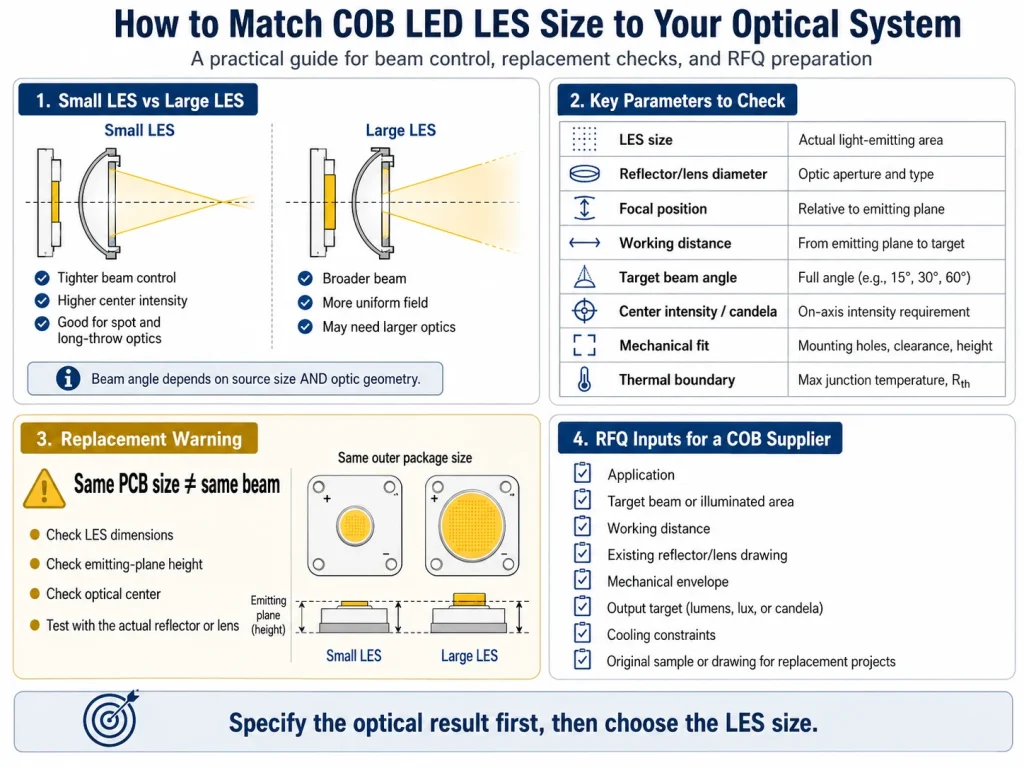
| RFQ Input | Information to Provide |
| Application | Spotlight, fill light, projection, inspection, or other equipment |
| Optical target | Beam angle, beam diameter, candela, or target area requirement |
| Working distance | Source to target distance |
| Existing optic | Reflector/lens model, dimensions, drawing, or sample |
| Mechanical envelope | Maximum diameter, height, holder, and mounting constraints |
| LES information | Existing LES or allowable range if already defined |
| Output requirement | Lumens, lux, candela, or other relevant target |
| Thermal boundary | Cooling structure and available thermal contact area |
| Replacement data | Original COB drawing, sample, fixture drawing, or failure photos |
If the correct LES is unknown, provide the target beam, working distance, optical envelope, and existing reflector or lens. Those inputs allow a COB supplier to evaluate whether a standard source, different optic, or custom emitting area is more appropriate.
When Does a Custom LES COB LED Make Sense?
A custom LES becomes more reasonable when the optical and mechanical boundaries are already defined but standard COB options cannot satisfy them together. Examples include a fixed reflector that cannot be changed, a restricted housing envelope, a required emitting shape, or a target beam that available LES options cannot achieve within the existing system.
IHY Lighting publicly supports COB customization and optical engineering as part of its broader IHY Lighting light source and module offering. Custom development should still begin with measurable application requirements rather than an assumption that a smaller emitting area is inherently superior.
How to Evaluate a COB LED Supplier for LES and Optical Matching Projects
For an optical critical project, a supplier should be able to discuss more than wattage and lumens. Buyers should request a clear LES definition, mechanical drawing, optical center information, intended operating conditions, and enough data to understand how the proposed source interfaces with the reflector, lens, holder, and cooling structure.
When a custom solution is being considered, the supplier should also be able to work from target beam, working distance, mechanical envelope, and other system constraints. Prototype approval should use the intended optics and housing rather than validating the COB as an isolated component.
This approach is particularly relevant to IHY Lighting’s publicly stated focus on COB sources, optical engineering, LED modules, and customized light source solutions. Product specific beam performance should nevertheless be verified for the actual COB optic combination being purchased.
Conclusion
COB LED LES size should be treated as an optical system parameter, not a standalone quality ranking. A smaller LES can support tighter beam control and higher center intensity with suitable optics, while a larger LES may make more sense for broad or uniform illumination. The correct choice depends on the target beam, working distance, reflector or lens, mechanical envelope, output requirement, and thermal boundary.
For a new design or replacement project, prepare the existing COB model or drawing, LES dimensions if known, reflector or lens information, target beam, working distance, housing constraints, operating conditions, samples or photos, and expected quantity. These details can be used to submit a COB LED optical matching project inquiry for a more application specific evaluation.
FAQs
What does LES mean in a COB LED?
LES means light emitting surface. It describes the luminous area of the COB, not the complete PCB or package size. LES dimensions and position are important when matching a COB to a reflector or lens.
Does a smaller LES always produce a narrower beam?
No. A smaller LES generally makes tight beam control easier when other optical conditions are comparable, but final beam angle depends on the source, reflector or lens geometry, focal position, and mechanical alignment.
Can I use the same reflector with a COB LED that has a different LES?
Possibly, but mechanical fit alone is not enough. Check the optic’s supported LES range, emitting plane position, focal relationship, and finished beam. Prototype testing is recommended before approving a replacement.
Is a larger LES better for flood or fill lighting?
It can be useful when broad coverage or uniform close range illumination matters more than maximum center intensity. The final result still depends on the diffuser or secondary optics, source geometry, and working distance.