



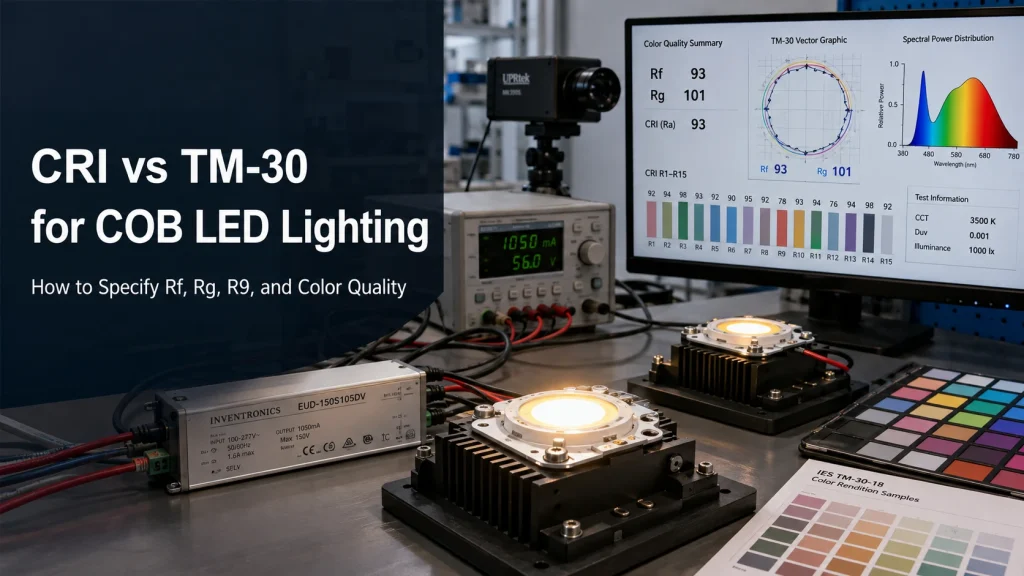
Two COB LEDs can both be labeled CRI 90 or CRI 95 and still render skin tones, fabrics, coatings, food, packaging, or photographed objects differently. For an OEM buyer, that is the practical reason to compare CRI vs TM-30 rather than treating a high CRI number as a complete color quality specification.
CRI remains useful, but projects that depend on accurate or intentional color appearance may need R9, TM-30 Rf and Rg, spectral information, and representative sample approval. The goal is not to replace every CRI requirement with a longer list of metrics. It is to specify enough information for the application and make supplier data genuinely comparable.
CRI vs TM-30: What Is the Difference for COB LED Selection?
CRI, usually reported as Ra, summarizes the average color shift of eight standardized samples. The Illuminating Engineering Society defines Ra as the average shift of eight intermediate saturation colors. That makes CRI convenient for initial screening, but an average can hide differences in individual colors.
ANSI/IES TM-30-24 takes a broader approach. It evaluates overall color fidelity, gamut area, and hue-specific behavior using numerical and graphical information. The method is intended for lighting specifiers, manufacturers, engineers, and designers, which makes it particularly relevant when a COB LED must be specified rather than simply described as “high CRI.”
When CRI Is Useful—and When a CRI Number Is Not Enough
CRI is still useful when comparing products against a familiar minimum requirement, screening suppliers, or working with a specification that explicitly calls for Ra. A CRI 90 or CRI 95 requirement can quickly eliminate sources that do not meet the project’s basic fidelity target.
The problem begins when buyers assume that two LEDs with the same Ra will produce the same visual result. DOE technical material shows that light sources with the same CRI can render individual colors differently because an average score hides those differences.
For general illumination, CRI may be sufficient for an early selection stage. For product display, photography, color matching, premium retail, inspection, or supplier substitution, additional color data becomes more useful. When the appearance of specific reds, skin tones, finishes, or branded colors matters, the next step should be to request R9, TM-30 information, spectral data, or a physical sample under representative conditions.
How to Read TM-30 Rf, Rg, and the Color Vector Graphic
TM-30 should not be treated as a single “better CRI” number. Its value comes from combining several pieces of information.
Rf describes average fidelity to a reference. Rg describes average gamut area, indicating whether colors are, on average, more or less saturated than under the reference. The Color Vector Graphic then shows how hue and chroma change across different color regions. IES TM-30-24 also includes local fidelity, local chroma shift, and local hue shift measures.
How to Interpret Rf and Rg Without Treating Them as “Higher Is Better”
Rf uses a 0–100 scale, with a higher value indicating closer average fidelity to the reference. However, the highest possible fidelity is not automatically the right design choice for every application. A project may value faithful rendering, deliberate saturation, or a balance between the two.
Rg needs even more care. A value above 100 indicates an average increase in gamut or saturation relative to the reference, while a value below 100 indicates an average reduction. It is therefore incorrect to treat a higher Rg as a universal quality ranking. DOE guidance emphasizes that Rf and Rg are average values and cannot, by themselves, show exactly which colors have shifted.
For purchasing, the better question is not “What is the highest Rg available?” but “What color-rendering behavior is required by the application?” A neutral color-matching task and a retail display designed to emphasize certain merchandise may call for different spectral choices.
When the Color Vector Graphic Matters More Than the Average Scores
Two COB LEDs can have similar Rf and Rg values while treating particular hue regions differently. That is where the TM-30 Color Vector Graphic becomes useful.
The graphic provides a visual representation of hue and chroma shifts around the hue circle. For applications where certain colors are critical, the graphic can reveal information that disappears inside average values.
This matters when evaluating skin tones, fabric, food, paint, product finishes, artwork, or camera facing objects. A supplier report showing only Rf and Rg may be adequate for preliminary screening, but a color critical OEM project may benefit from the complete report or supporting spectral data.
Why Two High CRI COB LEDs Can Still Render Colors Differently
A common replacement problem occurs when the original and replacement COB have the same nominal CCT and CRI, yet the illuminated object looks different after installation.
The reason is that neither CCT nor Ra uniquely defines the spectral power distribution. Different spectra can produce similar headline metrics while distributing energy differently across visible wavelengths.
Spectrum, R9, and CCT: What a Buyer Should Compare Beyond Ra
R9 is a useful supplemental metric because it describes saturated red rendering and is not included in the calculation of Ra. DOE notes that R9 can be particularly relevant to red objects and skin tones.
CCT also needs to be interpreted correctly. Two COB LEDs labeled with the same nominal CCT do not necessarily have identical spectra or identical color rendering. Duv, spectral power distribution, R9, and TM-30 results can reveal differences that a single CCT/CRI pair cannot.
For replacement or supplier substitution, compare the original and proposed COB under equivalent conditions. “Same wattage + same CCT + same CRI” is not enough when a visual match matters. If the application is stage or camera facing lighting, the existing guide to color quality requirements for stage lighting COB LEDs provides a broader application context that includes CRI, R9, TM-30, Duv, spectrum, and other system considerations.
When Should an OEM Specify TM-30 Instead of CRI Alone?
Not every COB LED project needs a full TM-30 requirement. Adding metrics without a clear application reason can make sourcing more complicated without improving the final product.
A practical approach is to increase the depth of color evaluation as the cost of color mismatch increases.
| Application Need | Suggested Evaluation Depth |
| Basic general illumination | CRI may be sufficient for initial screening |
| Product or material appearance matters | CRI plus R9 and relevant supporting color data |
| Comparing similar high CRI COB LEDs | TM-30 Rf/Rg and Color Vector Graphic |
| Color matching or inspection | TM-30, spectral data, and sample validation |
| Photography or camera facing lighting | Broader color evaluation plus application specific camera requirements |
| Replacement requiring visual matching | Compare original and replacement under equivalent conditions |
For photography and other color sensitive equipment, COB LEDs for photography and color-critical lighting provide a more relevant product path than a generic COB category. Final suitability still needs to be checked against the actual optical, electrical, thermal, and color requirements of the equipment.
How to Compare High CRI COB LED Supplier Data
Supplier comparison becomes unreliable when two reports were generated for different products, different CCTs, different current levels, or different system configurations.
Before comparing CRI 95 COB LEDs or reviewing TM-30 reports, verify that the data actually describe the configuration being purchased.
Check the Test Conditions Before Comparing CRI or TM-30 Reports
Confirm the exact COB model, CCT, operating current, and configuration associated with each report. Determine whether the data describe the LED source, a COB module, or a complete luminaire. For tunable or multichannel systems, the channel mix and operating point may also affect the result.
A summary value copied into a product table is less useful than traceable data tied to the proposed configuration. If color quality is important to product acceptance, request the relevant report or spectral information and approve an engineering sample before freezing the specification.
CIE’s 2025 position statement is also relevant to this transition in color quality specification. CIE now recommends broader adoption of its General Colour Fidelity Index Rf and a gradual replacement of traditional Ra in relevant specifications and standards, while recommending parallel reporting during the transition. This does not mean that “CRI has been replaced by TM-30”; rather, it reinforces the broader industry movement toward more informative color fidelity evaluation.
How to Avoid Color Mismatch in Replacement or Supplier Substitution
When changing suppliers or replacing a discontinued COB, build the approval process around the visual result, not only the catalog description.
Compare the existing and replacement source for CCT, CRI, R9, and any available TM-30 or spectral information. Then evaluate representative samples in the intended optical system and under the actual objects or materials that matter to the product.
This step is especially important when equipment from different production batches must look consistent. The safest prevention strategy is to define the approved color specification and the corresponding sample before bulk production rather than trying to diagnose color mismatch after assembly.
How to Write Color Quality Requirements for a COB LED RFQ
“Need high CRI COB LED” is not a complete RFQ. A supplier needs to know what the light is expected to render and how that result will be judged.
Start with the application and target CCT. State the required CRI or R9 where these are part of the project specification. If color fidelity, saturation behavior, or hue-specific shifts matter, request appropriate TM-30 data. If spectral matching is important, request spectral information rather than assuming that CRI or Rf alone describes the requirement.
Also provide the electrical operating point and any relevant dimming or multi-channel conditions, because the final approved color data should correspond to the configuration being evaluated.
When a standard source cannot meet the required optical, electrical, mechanical, or spectral target, custom COB LED color specifications for OEM applications can provide a framework for translating the application requirement into a manufacturable COB design.
How to Evaluate a COB LED Supplier for Color Critical Projects
A useful supplier evaluation should go beyond asking whether CRI 95 or CRI 98 is available. The supplier should be able to distinguish standard specifications from customized options, connect color requirements to the actual COB configuration, and provide enough information for the buyer to approve a representative sample.
IHY Lighting publicly focuses on COB LEDs, LED modules, integrated driver modules, optical modules, and application-specific optoelectronic solutions. IHY Lighting also publishes COB products and application content for photography, stage lighting, and other OEM uses. Its existing custom COB design guidance emphasizes defining measurable application requirements before design rather than starting from a vague request such as “brighter” or “higher quality.”
For color critical sourcing, that same principle applies: define CCT, color rendering intent, required metrics, operating configuration, and acceptance method before asking a supplier to recommend a source. Any product specific R9, Rf, Rg, Duv, or spectral performance should be confirmed for the proposed configuration rather than inferred from general company capabilities.
Conclusion
CRI remains useful, but it should not be asked to answer questions it was not designed to answer. When color quality affects product performance, OEM buyers can reduce sourcing risk by moving from a single CRI number to an application based specification using R9, TM-30 Rf/Rg, the Color Vector Graphic, spectral data, and sample approval where appropriate.
For a new or replacement COB LED project, prepare the target CCT, CRI requirement, critical colors or materials, existing product data, electrical operating conditions, drawings or samples, application, and expected quantity. These details can be used to submit a COB LED color-quality project inquiry for review without assuming that one metric fits every application.
FAQs
Is TM-30 better than CRI for LED lighting?
TM-30 provides more color rendering information than CRI, including average fidelity, gamut, and hue specific behavior. However, not every project needs the full method. The appropriate specification depends on how important color matching or color appearance is to the application.
Does CRI include R9?
Ra does not include R9 in its average. R9 is a separate special color rendering index for saturated red and can provide useful information for applications involving skin tones, food, fabrics, and other red sensitive materials.
What is a good Rf and Rg for LED lighting?
There is no single Rf/Rg combination that is ideal for every application. A high Rf indicates closer average fidelity to the reference, while Rg describes average gamut change. Requirements should reflect the desired color rendering intent rather than a universal “higher is better” rule.
Can two COB LEDs with the same CRI look different?
Yes. Two sources can have the same nominal CCT and CRI but different spectral power distributions, R9 values, or hue specific shifts. For color sensitive replacement or sourcing, compare additional color data and approve samples under representative conditions.